
KNUCKLEHEAD GARDENS
CREATIVE GARDEN & PERMACULTURE
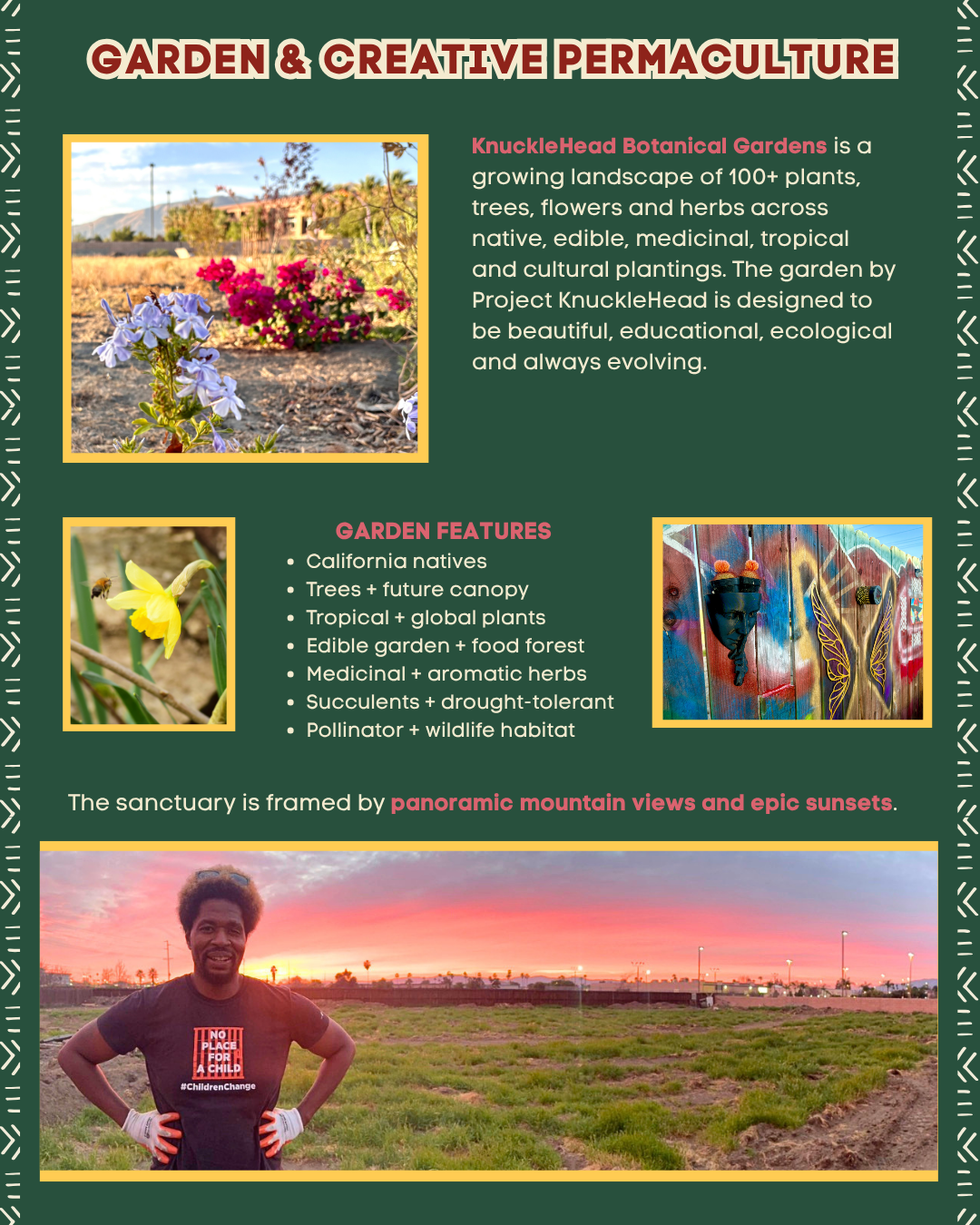
KnuckleHead Botanical Gardens is a growing 1.5-acre living landscape with more than 100 plants, trees, flowers, and herbs woven throughout Creative Soul Sanctuary. What began as largely open land is becoming a botanical experiment combining beauty, food, wildlife habitat, cultural memory, ecological restoration, and hands-on learning. In partnership with the non-profit Project KnuckleHead, this garden is evolving with the input of students passionate about the environment. Supported by: Arts for Healing and Justice Network.
100+ PLANTS, TREES, FLOWERS + HERBS
The collection crosses climates, continents, uses, textures, colors, and stories. Current and developing plantings include large canopy trees, flowering ornamentals, fruit trees, palms, tropical foliage, privacy plantings, culinary and medicinal herbs, succulents, food crops, pollinator plants, vines, wildflowers, and experimental growing systems.
Among the trees already helping shape the young landscape are African sumac, sycamore, Southern magnolia, jacaranda, crape myrtle, California pepper trees, purple-leaf plum, queen palms, Italian cypress, Indian laurel ficus, Carolina cherry, Eastern redbud, and white dogwood. Giant bird of paradise and other broad-leaf tropical plants add an entirely different layer of texture around the property.
AROMATIC + MEDICINAL GARDENS
Some parts of the garden are meant to be experienced with your nose as much as your eyes. The property includes more than a dozen aromatic and medicinal herbs, creating opportunities for sensory garden walks, herbal experiences, teas, culinary workshops, and conversations about the traditional uses of plants. Rather than treating herbs as decoration, the long-term vision is to connect plants to food, wellness, culture, scent, memory, and practical knowledge. Culinary, aromatic, and medicinal gardens will continue expanding as part of workshops and resident-led projects.
TROPICAL + GLOBAL GARDEN
Not everything here comes from the Southern California landscape. CSS deliberately mixes plants from different climates and parts of the world, reflecting the Sanctuary's broader interest in travel, diaspora, culture, and experimentation. Manolia, jacarand , giant bird of paradise, palms, figs, mulberry, and other global plantings sit alongside plants selected for the local climate. The result is less a traditional regional garden and more of a botanical journey through the places, plants, and cultures that have influenced the Sanctuary.
NATIVES + SUCCULENTS + WATER-WISE LANDSCAPES
A garden in this valley also has to understand heat. Succulents, drought-tolerant ornamentals, mulched growing areas, irrigation zones, and increasingly climate-adapted plantings allow the Sanctuary to explore what a lush landscape can look like in an arid Southern California environment. The garden is intentionally becoming a testing ground for balancing beauty, shade, water use, resilience, and habitat.
WILDFLOWERS + POLLINATOR GARDENS
Wildflowers and flowering plants are being incorporated throughout the landscape rather than contained in a single display bed. Some are planted for beauty, while others are intended to provide nectar, pollen, shelter, and seasonal resources for insects and birds. The Sanctuary also incorporates planting ceremonies into selected gatherings, allowing visitors to literally contribute to the future landscape. A wildflower seed scattered during one event may become part of what another visitor encounters months later.
TREES + CANOPY +ORCHARD + REGENERATIVE FOOD FOREST
One of the biggest long-term projects is simply growing shade. Dozens of young trees are being established throughout the Sanctuary to eventually create cooler gathering areas, wildlife corridors, privacy, wind protection, seasonal color, and a layered canopy over portions of the Creative Acre Trail.. Visitors can currently see the garden in a particularly interesting stage: some trees are substantial while others are still saplings. The goal is to document that transformation over years, allowing guests to watch what is now an open, sunny landscape gradually become a much more shaded and biologically complex place.
Featured trees include: African Sumac • Sycamore • Southern Magnolia • Jacaranda • Crape Myrtle • Purple-Leaf Plum • California Pepper • Eastern Redbud • White Dogwood • Italian Cypress • Indian Laurel Ficus • Carolina Cherry • Queen Palm
The garden is also the beginning of a regenerative food-forest ecosystem, where edible plants are integrated into the wider landscape rather than confined to a single vegetable patch. The emerging orchard currently includes Black Mission and Chicago Hardy figs, Fuji apple, and Pakistani mulberry, with additional fruiting trees, berries, vines, herbs, and perennial foods planned as the system develops. Over time, the goal is to create multiple edible layers: canopy and understory fruit trees, shrubs and berries, climbing plants, herbs, vegetables, groundcovers, and pollinator-supporting species.
A GARDEN FOR WILDLIFE
KnuckleHead Botanical Gardens is being developed as habitat as much as scenery. The brochure identifies the property as a Certified Wildlife Habitat, and the expanding garden has already been associated with noticeable increases in hummingbirds, butterflies, other pollinators, and birds visiting the property.
Water, flowering plants, tree canopy, shrubs, open areas, food sources, and places to shelter all create different habitat niches. Rather than trying to separate the garden from wildlife, the goal is to make wildlife one of the reasons to explore it.
WATCH FOR
Hummingbirds: Frequent visitors to flowering areas and increasingly visible as the garden develops.
Butterflies: Supported by flowering and habitat-oriented plantings throughout the landscape.
Bees + other pollinators:Essential partners in the garden and an important part of the future food-forest ecosystem.
Songbirds + other birds: Trees, fencing, grassland edges, open sky, water, and plantings create a range of perching, feeding, and resting opportunities. Local habitat supports everything from familiar grassland birds to raptors and seasonal visitors; the regional bird guide highlights species such as Western Meadowlarks, Mountain Bluebirds, Loggerhead Shrikes, Northern Harriers, and Tricolored Blackbirds.
POND + WATERSCAPE ECOSYSTEM
Water introduces another habitat into the garden. The pond, stream, and 12-foot waterfall are designed as both a restorative human space and part of the property's developing ecological system. The sound and movement of water create a completely different micro-environment from the dry open landscape surrounding it, attracting wildlife while providing one of the garden's central places for sitting, observing, and slowing down.
As plantings around the pond mature, this area can become one of the richest small habitat zones on the property.
ANCESTRAL + CULTURAL GARDEN
Plants can carry stories as powerfully as murals.
One evolving layer of KnuckleHead Botanical Gardens explores the relationships between plants, African and Afro-diasporic traditions, Indigenous knowledge, foodways, healing practices, spirituality, migration, and cultural memory. Rather than presenting these traditions as interchangeable, future interpretation and programming can identify where particular plants and practices come from and honor the communities that preserved that knowledge.
HONORING ANCESTORS & SACRED TRADITIONS
We draw inspiration from Afro-diasporic traditions while welcoming all backgrounds. Tribute and praise to the Orisha include:Eshu’s Trail, Orunmila’s Labyrinth, Yemaya–Olokun Pond, Oshun’s Waterfall, Osayin’s Herbs & Medicine Garden, Obatala’s Courtyard, Oya’s Wind Sculture, Ogun’s Fire & Tool Pit, Ochosi’s Archery Range, and Shango’s Axe Throwing.
REGENERATIVE EXPERIMENTS
THE GARDEN IS ALSO A LAB.
The property is intentionally being used to experiment with different ways of growing food and restoring land. The longer-term garden vision includes: Food Forests • Orchard Systems • Vertical Gardens • Trellises + Vines • Wildflower Zones • Berry Patches • Microgreens • Hydroponics • Greenhouse Growing • Keyhole Gardens • Wildlife Borders • Medicinal Gardens • Aromatic Gardens • Seed Saving • Compost + Mulch Systems • Water-Wise Irrigation
THE GARDEN AS A JOURNEY
The 1,000+ foot Creative Acre Trail moves visitors through different landscapes, activity spaces, water features, art, trees, wildlife habitat, and quieter garden pockets.
YOUTH + ECOLOGY
GROWING THE GARDEN. GROWING THE NEXT GENERATION.
KnuckleHead Botanical Gardens also serves as a living learning laboratory in partnership with Project KnuckleHead. Young people will be able to participate in fellowships and hands-on projects connecting gardening, ecological restoration, environmental stewardship, creative placemaking, public art, food systems, and land-based learning.
Rather than only studying environmental ideas in a classroom, fellows can help plant trees, restore habitat, grow food, build garden systems, document wildlife, create interpretive art, maintain trails, experiment with irrigation and watch their work physically transform the land.
The property's longer-term planning explicitly identifies botanical and environmental education, school and college partnerships, public art, ADA-accessible garden paths, and work-study opportunities as central parts of the garden's future.
PROJECTS INCLUDE:
Tree Planting + Care • Native Habitat Restoration • Pollinator Gardens • Food Forest Development • Seed Starting • Composting • Water Conservation • Wildlife Observation • Garden Art + Murals • Plant Identification • Environmental Storytelling • Garden-to-Café Projects